
Voters Face a $449 Million Question in Mesa Proposition 419
With declining enrollment, school consolidations, and a separate request for authority over surplus facilities, Mesa Proposition 419’s $449 million borrowing request raises questions about whether Mesa Public Schools has its long-term facilities plan in the right order.
Short on Time? Jump to the Bottom Line.
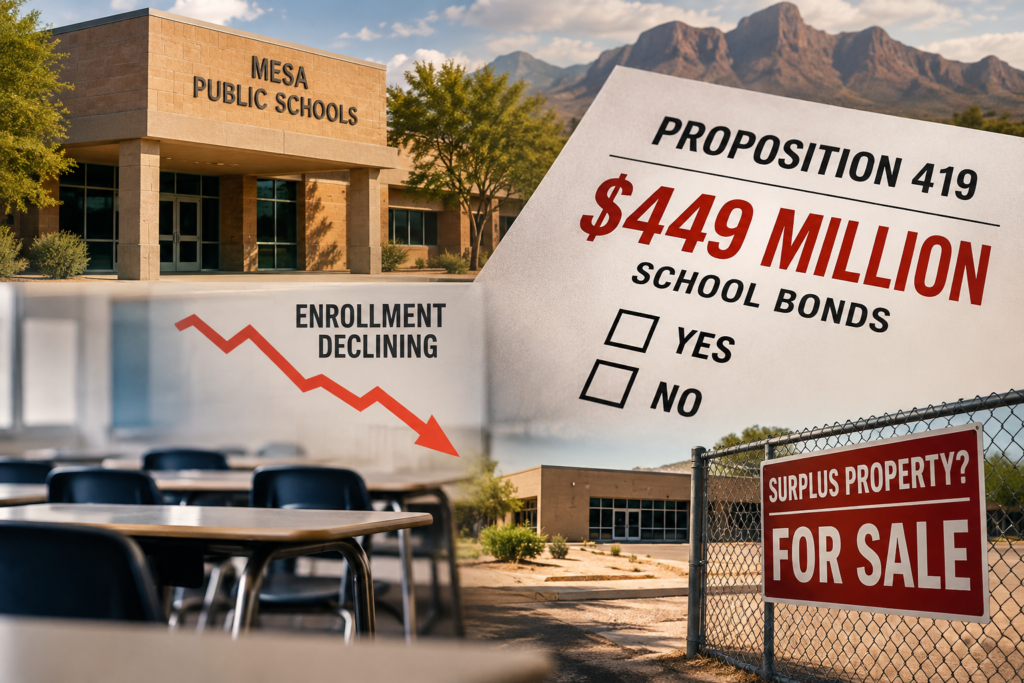
Mesa’s aging schools clearly require investment. The bigger question is whether the district should determine its long-term footprint, consolidate and repurpose facilities, and identify surplus property before committing taxpayers to another $449 million in debt.
Mesa Public Schools has a facilities problem.
Many of its buildings are old. Air-conditioning systems need replacement. Roofs, plumbing, fire protection, security systems, and technology require continued investment.
At the same time, Mesa Public Schools has another problem: it has fewer students to put in those buildings, and enrollment is projected to continue falling substantially.
Now voters are being asked to authorize another $449 million in borrowing through Proposition 419.
The question isn’t whether Mesa’s schools need maintenance. They clearly do.
The harder question is whether taxpayers should authorize nearly half a billion dollars in new debt before the district has finished adjusting its physical footprint to the number of students it expects to serve.
Mesa Is Already Adjusting to Fewer Students
Declining enrollment isn’t hypothetical.
Mesa Public Schools has acknowledged that declining student enrollment is creating budget pressure. In 2025, the district announced a restructuring that eliminated more than 40 district-level administrative and certified specialist positions, saving approximately $3.75 million annually. The district specifically described the changes as a response to declining enrollment and the financial pressures associated with it.
The district has also been reconfiguring how it uses existing campuses.
Wilson Elementary, for example, transitioned into Franklin Accelerated Academy at Wilson, with neighborhood students reassigned among Jefferson, Johnson, and Madison elementary schools. Franklin High School was placed on the existing Franklin Junior High/Brimhall campus, while Shepherd College Prep was established on the existing Shepherd Junior High campus. Mesa described these changes in part as a way to make effective use of existing district facilities.
Other consolidation is occurring at the program level. Mesa has consolidated some specialized programs, including closing Severe Intellectual Disability classrooms at Wilson and Zaharis elementary schools and moving those students to programs at other campuses.
ABC15 reported last year that the district was removing portable classrooms and downsizing space it no longer needed as enrollment declined.
All of that may be prudent.
But it also makes Proposition 419 worth examining more closely.
How Many Buildings Will Mesa Actually Need?
Enrollment has already declined significantly.
According to figures cited in reporting and Proposition 419 opposition materials, enrollment fell from 57,117 students in 2021-22 to approximately 51,093, with projections showing enrollment falling to roughly 39,196 by 2035-36. That would represent another 11,897 students lost from the district.
A smaller student population does not eliminate the need to maintain buildings.
But it should change the calculation about which buildings taxpayers should invest in.
If a district expects to serve substantially fewer students ten years from now, shouldn’t it first determine how many campuses it will need, which facilities should remain open, which should be consolidated or repurposed, and which properties are no longer necessary?
Mesa has faced this exact issue before.
A 2018 Arizona Auditor General performance audit found that after enrollment declined, Mesa closed three schools in fiscal year 2013. Those closures helped increase the district’s overall capacity utilization from 77% to 81%. Auditors specifically credited the district with taking steps to address excess capacity and control plant-operation costs.
That history matters.
Consolidation isn’t an abstract suggestion. Mesa has done it before, and according to the Auditor General, it improved the district’s use of its facilities.
Then There Is Proposition 420
The questions surrounding Proposition 419 become even more interesting because voters will find another Mesa Public Schools proposition immediately after it on their ballots.
Proposition 420 would give the Governing Board authority to sell, lease, or exchange five identified district properties. According to current reporting, the proceeds could then provide another source of capital resources for the district.
Proposition 420 does not eliminate Mesa’s infrastructure needs, nor would selling a handful of surplus properties generate anything approaching $449 million.
But consider what the two propositions represent.
Proposition 419 asks taxpayers to borrow against future tax revenues.
Proposition 420 allows the district to generate value from property it already owns.
The district may ultimately need both.
But voters should ask whether the sequence makes sense.
How much property does Mesa Public Schools ultimately need? What other facilities could become surplus as enrollment continues declining? How much capital could be generated by selling or leasing property the district no longer needs? And how much operating expense disappears when unnecessary facilities are removed from the district’s inventory?
Those questions should be answered before taxpayers commit to maintaining and improving a physical footprint built for a substantially larger student population.
$449 Million Doesn’t Solve the Problem
There is another important number voters should understand.
Mesa Public Schools estimates that it has approximately $1.4 billion in infrastructure needs. Proposition 419 would provide $449 million, less than half of that amount.
In other words, approving Proposition 419 does not solve Mesa’s facilities problem.
It funds part of it.
That makes prioritization especially important.
If Mesa had $449 million available tomorrow, where should the money go first?
Toward a building likely to serve students for another 30 years?
Absolutely.
Toward air conditioning, roofs, fire protection, plumbing, and security at schools the district knows it needs?
Those are easy priorities to understand.
But what about major investments in facilities that could become candidates for consolidation or repurposing as enrollment continues falling?
That is where voters deserve considerably more clarity.
What Exactly Are Taxpayers Buying?
Proposition 419 is a capital bond, not an operating override.
The money does not go toward ordinary classroom operating expenses such as teacher salaries. It finances capital projects including building renovations, HVAC systems, technology, security, fire protection, and other infrastructure.
That distinction matters because academic performance is frequently introduced into the bond debate.
Mesa’s academic outcomes are an important issue, but voting on a capital bond is not the same as voting on classroom instruction.
The more relevant question for Proposition 419 is whether the district’s proposed capital investments are the right investments, in the right facilities, at the right time.
And the district’s own project information provides useful examples.
Mountain View Shows Why the Details Matter
Mountain View High School illustrates the issue.
Approximately $16.5 million in Proposition 419 projects is identified for Mountain View.
The proposed spending includes approximately:
- $5 million for air-conditioning upgrades
- $3.5 million for “Student and Community Experiences”
- $2.7 million for technology systems
- $2.7 million for career and technical education
- $2.3 million for fire protection
- $1.8 million for IT network and cabling
- $744,000 for security upgrades
The listed projects total approximately $16.49 million.
Some of those expenditures are immediately understandable.
Air conditioning in Arizona isn’t optional. Neither is fire protection. Security and functioning technology infrastructure are legitimate capital needs.
But $3.5 million for something described as “Student and Community Experiences” deserves considerably more explanation.
That’s the second-largest category on the Mountain View list.
What specifically would taxpayers be purchasing for $3.5 million?
A voter shouldn’t have to guess.
Another Bond Before the Last Debt Is Gone
Proposition 419 also isn’t occurring in isolation.
Mesa taxpayers are already paying debt from previous bond authorizations. Proposition 419 would add another layer of borrowing.
The district and bond supporters argue that the tax rate can remain relatively stable as older debt rolls off and new debt replaces it. One current supporter of the measure has argued publicly that the tax rate could remain the same or even decline.
But a stable tax rate and no additional debt are not the same thing.
Proposition 419 authorizes $449 million in new borrowing.
That debt must eventually be repaid.
For voters, therefore, the relevant question shouldn’t simply be, “What happens to my tax rate next year?”
It should also be:
What are we borrowing, what will we ultimately repay, what assets will that debt finance, and how long will those assets actually be needed?
Mesa Voters Rejected a Similar Bond Three Years Ago
There is another piece of history worth remembering.
Mesa voters rejected a $500 million school bond in 2023. Proposition 419 returns three years later at $449 million.
That doesn’t mean today’s proposal should automatically meet the same fate. Facilities continue to age, projects deferred in 2023 did not disappear, and some needs may have become more urgent.
But voters who said no three years ago are entitled to ask what has materially changed.
Has the district reduced the size of its physical footprint?
Has it identified which facilities it expects to need after another decade of declining enrollment?
Has it prioritized essential projects separately from desirable improvements?
Has it determined what property can be sold, leased, or repurposed?
And has it demonstrated why $449 million is the appropriate amount to borrow now, rather than after more of those decisions are made?
This Isn’t a Question of Whether Schools Need Maintenance
They do.
Mesa’s buildings need roofs. They need air conditioning. They need plumbing and fire protection. They need security improvements. Aging buildings do not repair themselves simply because enrollment declines.
But responsible capital planning requires more than identifying things that need fixing.
It requires deciding which assets are worth continuing to invest in.
That is particularly important when a district is shrinking.
Mesa Public Schools is already responding to declining enrollment. It has reduced administrative positions, reconfigured programs and campuses, removed excess space, and is now asking voters through Proposition 420 for greater flexibility involving properties it owns.
Those actions acknowledge an important reality: the Mesa Public Schools of the future will not look exactly like the Mesa Public Schools of the past.
Before committing taxpayers to another $449 million in borrowing, voters should understand what that future district will look like.
How many campuses will it need?
Which facilities will remain?
Which will be consolidated or repurposed?
Which properties can generate revenue instead of consuming it?
Which Proposition 419 projects are essential regardless of those decisions?
And, perhaps most importantly, why borrow first and figure out the district’s future footprint later?
Mesa’s schools deserve buildings that are safe, functional, and appropriate for the students they serve.
Taxpayers deserve to know, among other things, that the district has decided which buildings those will be before borrowing another $449 million to improve them.
The Bottom Line is this:
Mesa Public Schools is asking voters to authorize $449 million in new debt through Proposition 419 at the same time the district is confronting significant enrollment declines and reconfiguring how it uses its facilities.
The key questions:
- Enrollment is shrinking. Mesa has already lost thousands of students, with enrollment projected to fall to roughly 39,000 by 2035-36.
- Consolidation and reconfiguration are already occurring. The district is moving programs, repurposing campuses, eliminating excess space, and adjusting operations as enrollment declines.
- Prop. 420 is also on the ballot. That separate measure would give the district authority to sell, lease, or exchange certain properties it owns, potentially generating money for capital needs.
- Prop. 419 doesn’t solve the entire facilities problem. The district estimates approximately $1.4 billion in infrastructure needs, while the proposed bond provides $449 million.
- Taxpayers are still paying existing bond debt. Prop. 419 would authorize another $449 million in borrowing, even if the tax rate remains relatively stable as older debt is retired.
- Some proposed projects need more explanation. Mountain View High School alone has approximately $16.5 million in proposed projects, including $3.5 million labeled “Student and Community Experiences.”
- Mesa has successfully consolidated before. After closing three schools in 2013, the district improved its overall facility capacity utilization from 77% to 81%, according to the Arizona Auditor General.
Pingback: Mesa Proposition 420: What Mesa Voters Should Know